Slideshow

GANGLAND NEWS

GANGLAND SLAYINGS

September 06, 2011

Vallucos gang members get life in prison for 'ice pick' murder


Cameron Park man accused of stabbing and killing a woman with an ice pick will spend the rest of his life in jail. After two and a half hours of deliberation, a Cameron County jury sentenced Ernesto Berlanga to life in prison for the August 2005 murder of Patricia Salas. The two had been fighting when he stabbed her in the neck and then fled the scene. Prosecutors previously identified Berlanga as a member of the Vallucos prison gang. Berlaga was already serving a 25-year sentence for gouging the eye of a fellow inmate at the Carrizales-Rucker Detention Center back in 2006.

September 05, 2011

Drug couriers killed in Chiang Rai


Two drug traffickers were killed and 22,200 methamphetamine pills seized late on Sunday night in a clash with a combined force of police and para-military rangers of the Pha Muang Force in Thoeng district of Chiang Rai province, police said. Pol Maj-Gen Songtham Alapach, the Chiang Rai police chief, said the combined police-ranger force laid in wait near Rom Pho Thong village in tambon Tap Tao of Thoeng district between kilometre markers 56-57 on the road to Phu Chi Fa mountain near the Thai-Lao border after learning that a drug gang would transport speed pills across the border from Laos. Late in the night, the combined force spotted five men carrying backpacks and AK47 rifles walking down from the mountain and ordered them to stop for a search. The smugglers opened fire and a 10 minute gunfight followed. After the clash, the police and rangers examined the area and found the bodies of two men who were killed in the fight.  One of them was identified as Laopho sae Wang, 50, a villager of Rom Pho Thong village, and the other was an unidentified Hmong from neighbouring Laos. The three other smugglers fled back across the border. A backpack containing 22,200 methamphetamine pills and a 9mm pistol were also found at the scene.

Gaylords charged with gun, drug and gang crimes


Police and federal agents swept through several suburban homes Tuesday, arresting members of the "Almighty Gaylords" street gang following an 18-month undercover investigation into allegations of drug dealing, gun trafficking and violent intimidation. Nine alleged members of the gang were charged with federal gun crimes, including selling an AK-47 assault rifle, and six others were charged with state drug and gang crimes, according to the U.S. attorney's office. Topics Juvenile Delinquency Crimes Gang Activity See more topics » Beginning in 2009, an informant inside the gang recorded conversations with gang members and bought guns and set up drug deals under the surveillance of investigators, led by the U.S. Bureau of Alcohol, Tobacco, Firearms and Explosives, authorities said. Once violent players in Chicago's decades-long neighborhood battles over integration, not much has been heard from the Gaylords since the 1970s. But the investigation, which involved ATF, Cook County sheriff's police and the Addison Police Department, lifts the curtain on the remnants of a gang that followed the white-flight path to the suburbs over the years. A secretive, somewhat ragtag network, the Gaylords in the western suburbs are often described as the "Gray Lords," a handful of middle-age men nostalgic over their youth spent brawling with Hispanics in the city's ethnic neighborhoods. "The Gaylords never were an especially organized gang, and gang life meant mainly drugs, alcohol, racism and fighting," said gang expert John Hagedorn, who teaches at the University of Illinois at Chicago. Having interviewed gang members over the years, he said they were "more of a model for racist, white youth than for an organized criminal entity." Investigators say the case shows a more serious threat. Other members were charged in a 2010 shooting, which the investigation revealed may have been related to internal gang strife. And the informant told investigators that gang members claimed the Gaylords carried out the 2009 murder of a North Side bar owner. Charged Tuesday were the alleged leader of the Addison faction of the gang, James Grace, 40, as well as Edward Rand, 46, and Daniel Springhorn, who allegedly supplied the gang with guns he purchased at Wisconsin gun shows. Springhorn, 56, known as "Stone Greaser," lives in Sharon, Wis., and Rand lives in far north-suburban Antioch. Other members arrested Tuesday live in Lombard, Villa Park and Elmhurst. The federal defendants are charged only with gun trafficking crimes, each of which carries a maximum penalty of 10 years in prison and a $250,000 fine. Three alleged members, including Grace's brother, Wayne Grace, were charged with felony drug crimes in DuPage County, according to the DuPage County state's attorney's office. Another three individuals were charged with associating with gang members, a misdemeanor. The case took shape when a longtime member who wanted out of the gang became a police informant. While many of the gang members, like James Grace, are unemployed ex-cons, some have strong ties to law enforcement. Alleged gang members identified by the investigation include a Cook County sheriff's deputy, an Elmwood Park auxiliary police officer, a Michigan corrections officer and the son of a former suburban police chief, according to law enforcement sources. None of the law enforcement officers associated with the gang have been charged in the case. Much of the gang's gun supply came from Wisconsin. At Springhorn's rural home, agents discovered a cache of guns that included assault rifles. Investigators found that Springhorn and Rand, who is prohibited from possessing firearms because he is a convicted felon, regularly bought weapons at gun shows in Wisconsin


coastal war between NorteƱos and SureƱos


on Aug. 14, when a group of teenage Norteño gang members pulled out a gun and shot two rival Sureños on a quiet residential street in broad daylight. Fear prompted Luis' mother, Teresa Mendez, to bring him and his sister Noela to a community meeting Tuesday night, which was organized by the San Mateo County Sheriff's Office in the wake of the shooting. "I want to know how to prevent situations like this," said Mendez, who believes there are gang members on her son's youth soccer team. Luis has told her he knows kids in his class who have already become Norteños and Sureños like their older brothers or cousins. But she didn't know her son had been offered drugs until a reporter asked him about it. It was at the Pillar Ridge mobile home community, a known gang hotspot, Luis said. "They were, like, 15 or 16," he said. "They told me they had some extra if I wanted it." More than 300 Coastsiders packed into a meeting room Tuesday for a series of Advertisement presentations that amounted to a master class on gang warfare. Locals were shocked to learn that Half Moon Bay is immersed in an all-out coastal battle between Norteños and Sureños, who have been threatening each other for months with coded graffiti in plain sight. One recent tagger painted the number "187," a reference to the California Penal Code section on murder. Retaliation is now a major concern and the Sheriff's Office has beefed up patrols. "It's a war that's going to be going on for some time, but it's a war that's worth fighting," Sheriff Greg Munks said. Officers have arrested four suspects: 21-year-old Christian Serrano DeLeon, who police believe is the gunman; Mason Paul Wessel, 19; Marco Antonio Barajas, 18; and a 17-year-old resident of Moss Beach. But even arresting every gang member in town won't make the problem disappear, officials acknowledge. They need the community's help to address the deeper crisis that's taken root when young people grow up together, go to the same schools, and end up joining rival gangs. Older gang members reach out to younger kids in middle school and offer them acceptance and a seductive feeling of power and belonging in the most vulnerable period in their young lives, according to sheriff's Deputy Mike Smyser. "They don't have much money. You can take a kid into town and buy him a cheeseburger, and you've got a friend," Smyser said. Meanwhile, their parents (mostly first-generation farmworkers) are often too distracted catch the warning signs before it's too late. They work long hours and don't notice changes in their children, Mendez said. "Latinos, we have to work a lot, but we don't really pay attention to the kids. We leave them around too much," she said. Smyser has spent 10 years tracking gang activity and juvenile crime as a school resource officer on the San Mateo County coast. He said the shooting was a major wake-up call. "I've seen fights with fists and fights with sticks. But I've never seen fights with guns," he said. Smyser has counted about 50 Norteños and 40 Sureños on the coast, two rival Mexican-American gangs that originated in the California prison system. They go by local names like Media Luna Norteños, Coastside Locos, and neighborhood-specific gangs like Moonridge Outlaws. Those numbers are modest as compared with gang sets in East Palo Alto or Redwood City, according to the Sheriff's Office, which estimates 2,000 confirmed gang members in San Mateo County affiliated with more than 50 gangs. In a small town like Half Moon Bay, it's not a mystery who's in a gang or where they congregate, said Smyser. A quick search on YouTube for one local gang turns up a video filled with youthful Norteños flashing gang signs, drinking beer and showing off their Half Moon Bay gang tattoos. By the time they reach high school, kids are already sporting gang colors: red for Norteños, blue for Sureños. Drug dealers wear purple. Half Moon Bay High School counselor Kira Gangsei said she's worked with many gang members to turn their lives around -- but it's not easy. "They don't care about school as much. Getting involved with drugs, selling drugs -- once that happens, it's harder to get them back on track," she said. The high school uses a number of classes, workshops and nonprofit programs to teach students about the dangers of gang life, drinking and unhealthy relationships. Many are led by former gang members. Now it's the community's turn. The shooting has already prompted neighborhoods to come together and form Community Watch groups, and locals have volunteered to paint over graffiti and mentor youth with the Sheriff's Activities League. "I'm not going anywhere. If it has to be me standing my ground, then yes, I'll embrace it," said Brett Bowers, a father of two who lives in the neighborhood where the shooting occurred.

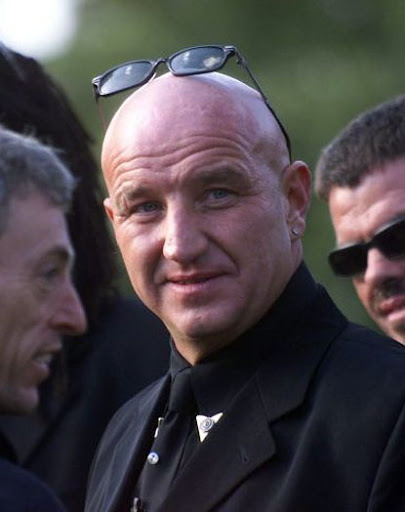
Dave Courtney believes the killer of his murdered stepson attended his funeral.


After burying gunned-down Genson, 23, at a huge funeral in south-east London, the notorious underworld leader of 'The Firm' mob said he could not sleep in the knowledge that the killer remains at large.
Clad in white, the 53-year-old was surrounded by minders from the Outlaw gang as he paid his last respects with his devastated wife and mother of Genson, Jenny.
Mourning: Dave Courtney with Genson's mother Jenny at the funeral of the gunned-down cage fighter
Murdered: Genson Courtney, 23, was shot dead while he waited in his car outside of his girlfriend's home in Greenwich
Genson, nicknamed 'G-Man', was ambushed as he got into his VW Golf outside his girlfriend's home in Greenwich, south-east London in July.
The victim, whose stepfather has written books about gangland violence, was blasted by a lone gunman in the head and shoulder before his assailant fled on foot.
Police suspect a major drugs baron owed thousands of pounds by Genson ordered his execution just before 11pm on Sunday.
There is also a theory he could have been lured to the area after being caught up in an ongoing feud between gangs.
But the Daily Star on Sunday newspaper says some sources from Genson's gang claimed to them that the shooting had been ordered by the young man's own stepfather.
They claim Mr Courtney, from Plumstead, South London, had a grudge against his stepson after he was beaten by him in a fight following a family row.
But the former debt collector, who claims to have been shot, stabbed and had his nose bitten off, rubbished the accusations.
'this has nothing to do with me and I honestly don't think ,y past has had any influences on my kid.
'Whether I'm gonna get chastised for this or not, I was aware what he was and I just tried to make him do that as much as possible. I could not have stopped this and I definitely didn't make it happen.'


    The Daily Star on Sunday said the gangster paid £2,500 for the coffin's plot in the send-off, which cost £4,00 and was held in Eltham.
    Killer on the loose: 'Dodgy' Dave Courtney, with wife Jenny, says he cannot sleep knowing that the person responsible for Genson's death is still out there
    Killer on the loose: 'Dodgy' Dave Courtney, with wife Jenny, says he cannot sleep knowing that the person responsible for Genson's death is still out there


    Send-off: Hundreds turned out to pay their respects to the 23-year-old, whose execution police suspect was ordered by a drug baron
    Send-off: Hundreds turned out to pay their respects to the 23-year-old, whose execution police suspect was ordered by a drug baron
    Courtney, who was jailed in the Eighties for attacking five men with a meat cleaver, also boasts that he has been involved in assault and murder.
    He often focuses on his links with Reggie Kray and the infamous criminal Lenny McLean and is said to be a central figure in a loose collection of villains who refer to themselves as The Firm.
    He refers to himself as Dave Courtney OBE – 'One Big Ego' - and has a painted depiction of himself as a knight on his house.


    July 05, 2011

    GANGSTER "Dodgy" Dave Courtney choked back tears last night after his stepson was shot dead - and said: "He was a proper little solja and I was proud of him."

    GANGSTER "Dodgy" Dave Courtney choked back tears last night after his stepson was shot dead - and said: "He was a proper little solja and I was proud of him."
    He pleaded for calm as cops feared a tit-for-tat gang war could erupt over the hit on Genson Courtney, 23.

    Cagefighter Genson was ambushed on Sunday night as he got into his VW Golf outside the home of his girlfriend Ginny.


    Ambushed ... Genson Courtney
    He was shot in the head and shoulder and died in hospital early yesterday.
    The murder in Greenwich, South East London, is believed to have been ordered by a drugs baron crossed by Genson - suspected of recent robberies on low-level dealers.

    Underworld legend Dave, 53, said: "If anyone needed an advert to say crime doesn't pay then let Genson be that advert."

    Dave - hardman, writer, actor and the model for Vinnie Jones' character in movie Lock, Stock and Two Smoking Barrels - added: "Genson had a lot of friends who are ready to take revenge. I'm trying to keep a lid on that.

    "He was a naughty boy but I was proud of him. He was a man's man.

    "We were close - and even shared a cell when we were both in jail earlier this year."

    Genson's mum Jenny, 42, said at home in Plumstead, South East London: "We're torn to pieces."

    Jamie Michael Cliff sentenced to 25 years for killing ex-girlfriend and her roommate

    Convicted killer Jamie Michael Cliff should spend at least 25 years behind bars for stabbing his ex-girlfriend 19 times and slitting the throat of her room-mate before lighting him on fire, B.C. Supreme Court Justice William Ehrcke ruled Monday.

    It was only the second time in B.C. history that a judge ruled that a killer convicted of second-degree murder must serve a minimum of 25 years in jail before being eligible for parole.

    A jury convicted Cliff June 10 of two counts of second-degree murder for attacking Lana Marie Christophersen, 26, and 21-year-old Andrew Gawley in east Vancouver on October 25, 2008.

    The only other person guilty of second-degree murder who was ordered to spent so long in jail is serial killer Robert Pickton, convicted in December 2007 in the slayings of six women.

    A second-degree murder conviction carries a life sentence with a minimum parole eligibility period of 10 years, where as a first-degree conviction carries an automatic term of 25 to life.

    Ehrcke said "these two murders fall into the worst group of offences and Mr. Cliff is a member of the worst group of offenders."

    Cliff, 36, sat emotionless in a dark sweater and white shirt as Ehrcke said the deaths of Christophersen and Gawley were "particularly brutal, pointless and without provocation."

    "These were senseless, cruel and cowardly murders," he said.

    He called Cliff "a merchant of misery" for his years manufacturing and selling methamphetamines and other drugs.

    And he said Cliff had been given numerous chances at rehabilitation after dozens of previous convictions, including 13 for assault and one for manslaughter.

    "All the previous attempts at rehabilitation have failed," Ehrcke said. "Mr. Cliff has been in trouble with the law more or less continually since his first conviction for assault when he was just 13 years old."

    The judge noted that Gawley, who didn't even know Cliff, was stabbed in the throat as he lay in bed, then doused with gasoline and set on fire as he called 911. Gawley survived the attack, underwent surgery and skin grafts and died three months later of infection at Vancouver General Hospital.

    "Mr. Gawley must have suffered terribly for the three months he lived in hospital," Ehrcke said.

    As the judge announced the rare maximum term, relatives and supporters of the two victims sobbed and cheered in the public gallery.

    A former boyfriend of Christophersen's gestured at Cliff as he was led away by sheriffs and Cliff responded by showing the spectator his middle finger.

    Several of Christophersen's relatives wore pins with her photo on it.

    The young woman had dated Cliff for several months in 2008, living with him briefly in a fortified house from which he sold drugs. She broke up with him and moved out, taking a one-month sublet for October in Gawley's east Vancouver apartment until her new place was ready.

    Gawley was not even in Vancouver for part of that month as the film school graduate was off doing charity work for World Vision.

    Christophersen had been with Cliff the night before she was slain at a Richmond drug house, where the two had fought. They took a taxi to Gawley's apartment about 4 a.m. Oct. 25.

    About four hours later, neighbours heard Christophersen screaming "he's going to kill me" and Ehrcke said she was likely being stabbed at the time.

    Cliff then went to Gawley's bedroom and told him "that Lana was dying" as he stabbed Gawley in the throat.

    "It is okay to give up - you are dead, you are dead. Go to sleep," Cliff told Gawley, according to statements the victim gave to police before he died.

    Cliff fled the scene and called a number of gang associates to help him hide out, but was arrested a few days later.

    Cliff's lawyer Jim Heller had argued for a minimum jail term of 17 or 18 years, saying "this was not the worst of cases and Mr. Cliff is not the worst offender."

    And he highlighted Cliff's difficult childhood: an alcoholic father and drug attack-prostitute mother who gave him up at 12. He was likely sexually abused as a child, the court heard.

    He bounced from group home to group home as a teenager and was constantly being in trouble with police, except for a brief stint as a military cadet which he loved.

    But Ehrcke rejected Hellers's submissions, saying Cliff deserved the maximum sentence for his brutal crimes.

    "I find this necessary for the protection of the public," Ehrcke said.


    Boyfriend's anguish over Emily's death

    The boyfriend of a New Zealand teenager who died mysteriously in the United Kingdom has spoken publicly for the first time, saying it was "disgusting" that he became a suspect in her death.

    Emily Longley, 17, died at boyfriend Elliot Turner's Bournemouth home in May. How, though, remains unclear.

    "I don't know. All of us don't know how she died," Turner said.


    Love of his life ... Elliot Turner with Emily Longley.
    "It is weird. God works in mysterious ways."

    Detectives initially thought drugs were to blame, but toxicology results ruled that out. Police are still investigating and Turner was arrested, but not charged.

    Dorset police said they had extended Turner's bail "to grant detectives the time necessary in order to fully investigate all relevant lines of inquiry".

    Turner, 19, said he had been "living in a nightmare" since the death of his girlfriend, from Auckland.

    "I find it actually disgusting and hurtful the police arrested me," Turner said. "I knew more about that girl, her secrets, her worries than anyone else and I ... sit here and think, not only has the girl I loved so much passed away, I was under suspicion, which I could not believe.

    "I'm still here at my house missing Emily more than anyone."

    While no funeral has been held for Longley - her body is still with police - a service was held in England which her New Zealand-based parents attended. Turner could not go.

    "My bail conditions prevented me from attending the memorial so I never got to say goodbye to the person I loved more than anyone."

    Turner said he did not provide his girlfriend drugs on the night she died.

    "The toxicology report was negative, I did not give her any drugs and the post-mortem was inconclusive."

    Turner said it was difficult dealing with the media attention when Longley died. Turner said people on Facebook accused him of being involved in gangs and drug dealing.

    "I was privately educated from a respectful family of jewellers and silversmiths not a gangster.

    "Imagine being in my shoes, it's like I'm living in a nightmare and so many ridiculous rumours were spread. Some people accused me of being a gangster ... a big-time drug dealer, which was a pack of lies."

    It was reported that Turner and Longley, known to friends as "Barbie", had a whirlwind on-and-off relationship. Turner painted a picture of a perfect love.

    "We truly had so many amazing memories and romantic times I will never forget.

    "Many weekends away, going out for dinner three times a week, clubbing twice a week and I'd speak to her every day for three hours on the phone ... we just clicked when we met."

    The pair "were very similar".

    "I saw a part of Emily no one else saw. A cute girl who realised she did not have to put on a facade in front of me.

    "I never judged her and she could be completely herself."

    Turner said he had sought help for depression since Longley's death.

    "I can't stop thinking about her.

    "It doesn't seem real. I still have the mini love notes and letters I keep in my wallet and read them every day."


    Reputed gang member, Roland Chin, is facing numerous weapons-related charges, after a recent traffic stop.


    A later search of an Escalade – believed to be obtained by crime — revealed a loaded handgun hidden in a cardboard box under its hood.

    Acting Staff Sgt. Jason Walker, with the organized crime section’s community response unit ,said Chin was arrested on June 12 during a traffic stop in a black Escalade.

    While police believe it was obtained by crime, and fraudulently registered to Chin, Walker said they do not know whether he was aware of those details or not, saying he may be “a legitimate victim.”

    He is not facing any charges in relation to the vehicle and the investigation is ongoing.

    Walker said police were searching for the vehicle not Chin when the arrest was made in the early-morning hours of June 12.

    "Our investigation led us to believe it was obtained by crime and we made our frontline officers aware of the vehicle and that's how we found it," he said.

    "Mr. Chin was cooperative."

    Chin, who was sent to prison for 23-months for weapons and drug-related convictions, lost his brother Roger in a gang-related shooting in 2008.

    Last July, Chin was given statutory release on those charges to serve the rest of his sentence in the community.

    In August, Calgary police arrested him in a traffic stop wearing a bullet-proof vest , carrying two cell phones and he also had a pocketknife.

    By November 2009, a National Parole Board panel revoked his release and sent him back to prison.

    Chin, who has always denied being a gang member, said the phones belonged to his father who forgot them in the car and that, given fears by police he might be targeted in gang violence, the vest was for his protection.

    At the time the panel said the decision was reached because Chin failed to follow conditions — including not having a cell phone, adhering to a curfew and avoiding gang members — imposed upon him.

    "I'll be 26 in a month, I'm getting old, too old for this," he told the two-member panel at the time.

    "I was trying to get my life together but it didn't work out too well .. I was trying."

    At the time it was anticipated Chin’s new statutory release date would be in early 2011.

    It is not known exactly when he was released again.

    Walker said it is a relief to seize the loaded gun in the latest dealings with Chin.

    "It comes down to public safety - there we have a loaded firearm in a vehicle being driven around on the streets," he said.

    "To what end, I don’t know ... nothing good can come of it."

    Chin is remanded in custody until July 6.

    He is charged with numerous weapons-related charges including carry a concealed weapon and possesses an unlicensed weapon.

    THE stepson of celebrity gangster Dave Courtney has been blasted to death in a gangland execution

    THE stepson of celebrity gangster Dave Courtney has been blasted to death in a gangland execution, it emerged yesterday.
    Genson Courtney, 23, was shot in the head at close range as he sat in a car close to London’s O2 Arena.
    Detectives are investigating the theory that he was lured to the spot after being caught up in a feud between rival gangs.
    The suspected gunman was seen running away.
    The death is a crushing blow to Dave Courtney, who rose to fame in the 1990s as a self-styled gangland enforcer.
    Bragging of friendships with notorious gangsters including the Kray twins, the 52-year-old claimed to be the model for the Vinnie Jones character in the movie Lock, Stock And Two Smoking Barrels.
    Genson was shot as he sat in a black Volkswagen Golf in Banning Street, Greenwich, shortly before 11pm on Sunday, Scotland Yard said.
    Police found him slumped in the car with gunshot wounds to his head and shoulder.
    Paramedics rushed him to hospital where surgeons fought to keep him alive but he died in the early hours of yesterday.
    Speaking at his home in Plumstead, south London, Dave Courtney said: “I’m shell-shocked.
    “Police have been here all day and they are inside now so I don’t want to say anything other than I’m devastated.”
    Officers from the Yard’s Operation Trident squad, which investigates shootings in the black community, are appealing for witnesses.
    Detective Chief Inspector Mark Gowe said: “At this early stage, it is believed a male suspect may have ran from the scene in the direction of Christchurch Way, Greenwich, shortly after the shooting.


    “I am appealing to anyone who may have seen or heard anything suspicious to contact the police.” He added: I would like to reassure anyone that Trident has great expertise in protecting witnesses and there are a huge variety of measures that can be put in place to protect you.”
    Dave Courtney’s claims of gangland connections have been questioned in the past.
    He was only nine when the Krays were jailed, but he claims to have arranged security for Ronnie Kray’s funeral in 1995.
    He also bragged that he has been shot at, stabbed and had part of his nose bitten off during his “tough guy” career in the underworld.
    In 2004 he was cleared of attacking his wife, Jennifer Pinto, over an alleged lesbian affair.
    Four years earlier, he walked free from the Old Bailey after he was cleared of taking part in a plot to plant cocaine on an innocent woman.
    During the trial, he was named as a registered police informant using the alias “Tommy Mack”.
    But Courtney insisted he simply took advantage of the system to disguise a relationship with a corrupt detective.
    “I have never been a grass,” he said.

    June 29, 2011

    Gangster gunned down in 'targeted' killing

    The Vancouver man who died of multiple gunshot wounds in North Surrey's Bolivar Heights neighbourhood Friday afternoon has been identified as 24-year-old Christopher Reddy.

    Reddy was gunned down in the street, in the 13100-block of 111th Avenue, at about 3:40 p.m.

    "This is gang-related and certainly targeted," said Sgt. Peter Thiessen, spokesman for the Integrated Homicide Investigation Team.

    Thiessen added Reddy was "well-known" to police throughout the Lower Mainland.

    If investigators know what the Vancouver man was doing in these parts when he was killed, they're not letting on.

    "He does have a connection to that part of Surrey," Thiessen confirmed, but he wouldn't divulge what that connection was.

    Reddy has been described in media reports as a gangster.

    As for his affiliations, Thiessen said, "We're still working on that."

    Meantime, homicide investigators pored over the crime scene until Sunday evening, hunting for clues.

    "As a result of the extensive search, there is no indication that any homes or citizens' vehicles were impacted by this shooting and no innocent bystanders were injured," Thiessen said.


    June 28, 2011

    The dark soul of Whitey Bulger

    The recent capture of Boston crime boss James (Whitey) Bulger after more than 16 years on the run should make us think about why creatures from the dark side have been so popular in American culture. Too often, gangsters are portrayed as tragic heroes. Sure, when they die, it might be tragic; but these are far from great men.

    Gregory Peck once explained that audiences love villains because they surprise with their willingness to live by no rules other than their own. It is said that Bulger strangled a young woman, apparently cutting off hands and removing teeth to prevent identification. He was what he was - and no more than that.

    That is why the victimized feel no more than "satisfaction and despair," as the relative of one of the 19 people whom Bulger supposedly killed said.

    From his first arrest in 1943 on the same streets of Boston where he would later make his name, Bulger spent more than 60 years being a bad boy.

    The man called Whitey did it all, from small theft to extortion to the kinds of terrifying murders that cement a reputation in the dark and bloody streets of the shadow world.

    And yet Bulger and his girlfriend, Catherine Greig, did not make a big fuss last week in California. They were tricked into venturing outside their home, where the FBI made the collar. It may have seemed overblown, but all the casual killings had made the gangster a true menace to society.

    Few of Bulger's "colleagues" share any of the glorified traits Hollywood peddles - and yet the image of the heroic gangster remains.

    Gangster films had become petty earners until "The Godfather" reignited the trend when it was released on the silver screen in 1972, delivering iconic characters and phrases that are today known the world over. The trend was most recently reignited in the HBO series "The Sopranos," in which protagonist Tony Soprano updated the image of the Italian-American gangster.

    Interestingly, "Sopranos" creator David Chase told me that he was bewildered by the fact that the public loved Tony, even though Chase and his writers routinely reminded their viewers that he was a vicious murderer and extortionist.

    Martin Scorsese has never had that problem. He knows that gangsters are excrement stuck to the bottom of society's shoe. Unlike the criminals celebrated in gangster rap, Scorsese's goons never make it to high places - and if they do, they don't stay there for very long.

    The casual gore of Jack Nicholson's Irish mob boss in Scorsese's "The Departed" is a far cry from Tony Soprano's suburban drama or Don Corleone's world of familial loyalty, twisted ethics and pervasive violence. Based loosely on Bulger, Nicholson's character, Frank Costello, perfectly shows the top-of-the-line gangster as a poisonous ball of slime, however outwardly shining. There it is.

    Audiences may love villains, but they do not misunderstand who those villains really are when artists like Scorsese take on the task of putting them in realistic narratives. Perhaps our greatest living American director, he does not deny them their humanity but also never fails to make it clear that these are indelibly corrupted human beings, without a doubt. Like Bulger, they suffer from advanced ethical cancers that eat them away but also gobble up the world outside of them.


    GANGLAND Slayers were present at Peter Piper Pizza

    GANGLAND Slayers were present at Peter Piper Pizza , restaurant located in the shopping center Plaza Bella Anahuac, the Sendero Avenue North, in the municipality of Escobedo, Nuevo Leon. It all began when five men came to unknown parking of Instead of a car and fell Platina white, then three of them entered the pizzeria and is seated at a table , sat for several minutes, the other two were at the gates of the business . The place was packed with children and parents Family enjoying the food and games, like a quiet evening and fun. The men unknown who had just entered the place located two youths who were on a table , one of them was holding the order number, waiting their turn, when suddenly began to hear gunshots

    The strangers were armed, were hit men, and made ​​a planned attack, fired at two youths who were going to eat at the pizzeria. On hearing the explosions customers and employees instead fell to the floor while the children cried and screamed at what was happening. After attacking the two young men, the five gunmen fled in the vehicle Platina. Employees place called paramedics who went away, had a run, and his companion was seriously injured.
    Elements of the Municipal Police were also present to protect the business , as children, youth and adults watched terrified by the situation, the panic was evident, some went into nervous breakdown. Staff Medical Examiner lifted the corpse of the man who so far remains as unknown. The wounded boy was taken to a hospital where they receive care. And so far the killers have not been located.

    Known gangster shot, killed in targeted hit

    A Vancouver gangster who was on bail on gun charges has been identified as the victim of a fatal shooting in Surrey last week.

    Christopher Reddy, 24, was shot to death in a targeted hit about 3: 30 p.m. Friday.

    Police were called to the 13100-block of 111th Avenue by residents in the area who heard gunshots.

    Sgt. Peter Thiessen, of the Integrated Homicide Investigation Team, said police were at the scene throughout the weekend doing an extensive search.

    "As a result of that extensive search, there is no indication that any homes or citizens' vehicles were impacted by this shooting and no innocent bystanders were injured," Thiessen said.

    Reddy was one of two gangsters charged last October after being stopped allegedly in a vehicle with a firearm.

    He was due to go to trial in September.

    Reddy was also convicted on four gun charges in February 2008 and sentenced to 18 months in jail and a 10-year firearms prohibition.


    June 05, 2011

    Two alleged gang members charged with murdering a rival in San Rafael pleaded not guilty Thursday.


    Bryan Sandoval Rocha, 17, and Carlos Eduardo Gutierrez, 18, could face life in prison in the slaying of Jeffrie Lee Olmstead. Police said Olmstead, 21, of Corte Madera was stabbed May 11 after a fight between two rival Hispanic gangs.

    Rocha, who was charged as an adult, is suspected of delivering the fatal wound.

    "Even if we take all of the allegations at face value, it appears to be self-defense," said Rocha's lawyer, Steve Shaiken.

    Two other suspects, both juveniles, are charged with gang participation.

    more than 100 people witnessed the shooting, but only one came forward. The gang-related case, like Shelton’s killing, remains unsolved.

    citywide crackdown on gangs and guns, teams of law enforcement officers made 129 arrests in the Tulsa area in May, authorities announced Thursday.

    Operation Triple Beam II was patterned after a similar crackdown last summer that was credited with a reduction in violent crime. The term “triple beam” refers to a scale used in illegal drug sales.
    The goal of both operations was to investigate gangs, arrest fugitives and take guns off the street.
    Chad Hunt, deputy U.S. marshal for the Northern District of Oklahoma, said Tulsa Police Chief Chuck Jordan approached him about doing another Operation Triple Beam after a spate of shootings.
    Jordan called it a perfect example of successful federal and local law enforcement collaboration.
    “I will say there is one good reason for the success of this, and that is we targeted the right people. If we start having an uptick, we will do the same thing again,” he said.
    On May 2, the U.S. Marshals Service, the Tulsa Police Department and the federal Bureau of Alcohol, Tobacco, Firearms and Explosives launched Operation Triple Beam II. It ended after two weeks.
    Hunt said officers focused on high-crime areas and known gang members. One of the main goals was to collect current information about gang members.
    “We wanted to know who are the worst of the worst gang members who are there causing all of these violent crimes,” he said.
    The officers fanned out across the city and patrolled areas that crime analysts have identified as having gang and violent crime. They also responded to crimes in progress to aid patrol officers.
    One evening on patrol at several apartment complexes, Officers Heath Cannon and Shawn Hickey pointed to several shooting scenes in the space of a few blocks. The crime scenes exemplified why Operation Triple Beam was needed, police said.
    Flowers sat in an empty lot in the 2000 block of N Quaker Avenue, where school kids found the body of Kendrich A. Shelton, 19, in March.
    Then, officers passed the vacant Chicken Hut restaurant near 1500 E Apache St., where Valentino Verner, 27, was killed Feb. 28, 2010.
    Witnesses stepped over his body to get their food, and more than 100 people witnessed the shooting, but only one came forward. The gang-related case, like Shelton’s killing, remains unsolved.
    On another street, the officers pointed out a house that was a known gang hangout. Young children in the yard watched as the officers drove by. On another street, the officers noted a house where cars had been known to line up to buy drugs.
    Jordan said firearm assaults have been halved since the crackdown.
    Other agencies that participated in the sweeps include the Broken Arrow, Claremore and Pryor police departments, the Tulsa and Rogers County sheriff’s offices, the Secret Service, the Oklahoma Department of Corrections and the Oklahoma Bureau of Narcotics and Dangerous Drugs Control.

    Police step up action after gang killings

    Hanover Park mother is hopeful that beefed-up policing in the area could see her son, a former member of the Americans gang, return home.

    The mother, who refused to be named to protect her son, said she feared there was a hit out on her son, and that he would be killed by his own gang if he came home.

    “It’s terrible the way they carry on here. Sometimes they have shootouts the whole week. Our kids are not safe here and you fear for their lives.

    “My son is too scared to come home and as a mother that’s all I want.”

    The woman, who lives in a block of flats close to the taxi rank where 23-year-old Ashraf Booysen, a taxi guard, was gunned down on Tuesday, was speaking after an anti-crime operation in the area on Thursday morning, which saw a 200-strong police contingent raid 20 houses identified as possible havens for criminal activities.

    Booysen’s murder was the second in three days.

    Last Sunday Elton John Williams, 30, believed to be a member of the Americans gang, died after being shott, allegedly by two members of rival gang the Mongrels.

    Since last month the area has seen a spike in gang-related shootings, prompting police to step up patrols.

    Yesterday’s operation took in members of law enforcement, the metro police, SAPS, traffic police and local nurses.

    Nyanga cluster commander Robbie Roberts said Hanover Park was only the first area targeted for operations. Others included Manenberg, Athlone and Philippi.

    Starting at 7am, and following tip-offs from the community, police raided 20 homes.

    “We started off with a ‘hard approach’ checking for drugs and firearms.”

    He said vehicle control points were also set up after information revealed that drugs were being moved in the early mornings.

    Eight people with various traffic violations were arrested at several roadblocks, and fines totalling R49 000 were issued.

    Another three people were arrested, one for possession of dagga and two on outstanding warrants of arrest, while 68 traffic fines totalling R38 000 were also issued.

    During May 108 arrests were made in the area for drug-related crimes and 19 unlicensed firearms confiscated.

    Roberts said confiscating guns before they could be used meant they were preventing crimes.

    In addition, “many times the weapon can be linked to another crime, or we can link the person with the weapon to another police problem”.

    After 9am the operation switched over to the “soft approach”.

    Visiting 40 flats, six groups conducted foot patrols door-to-door dishing out flyers to residents on crime prevention.

    Roberts said the “softer” stance was in line with the vision of provincial police commissioner Arno Lamoer.

    “It’s not just about driving around in a van for eight hours. Visibility is to get out of the car, knock on doors and approach people – speak to the residents in the area.

    “We are going to sustain this and ensure we will end violence with this approach.”

    He said they also intended joining forces with the education department to tackle school violence.

    Resident Alawayah Abdurahman, 43, welcomed the extra policing, but said it should not only be done after shootouts.

    “It was nice to see them so visible, and I hope it will make the gangsters rethink that they should take heed of other people’s lives.”

    After the police had been to her home, the fearful mother who longs for her son’s return said it was by time that police “took a hard stand” against gang violence.


    Monterrey falls, Mexico falls

    Mario Ramos thought it was a bad joke when he received an anonymous email at the start of this year demanding $15,000 a month to keep his industrial tubing business operating in Monterrey, Mexico’s richest city and a symbol of progress in Latin America.

    Sitting in his air-conditioned office looking across at sparkling office blocks dotting the mountains on that morning in January, he casually deleted the email as spam.

    Six days later, the phone rang and a thickset voice demanded the money. Ramos panicked, hung up and drove to his in-laws’ house. It was already late and he had little idea what to do. Then, just after midnight, masked gunmen burst onto his premises, set fire to one of his trucks, shot up his office windows and sprayed a nearby wall with the letter “Z” in black paint, the calling card of Mexico’s feared Zetas drug cartel.

    “They were asking for money I could never afford,” said Ramos by telephone from San Antonio, Texas, where he fled with his family the next day. “I should have taken the threat more seriously, but it was such a shock. I couldn’t quite believe this could happen in Monterrey.”

    In just four years, Monterrey, a manufacturing city of 4 million people 225 kilometres from the Texan border, has gone from being a model for developing economies to a symbol of Mexico’s drug war chaos, sucked down into a dark spiral of gangland killings, violent crime and growing lawlessness.

    Since President Felipe Calderon launched an army-led war on the cartels in late 2006, grenade attacks, beheadings, firefights and drive-by killings have surged.

    That has shattered this city’s international image as a boom town where captains of industry built steel, cement and beer giants in the desert in less than a century – Mexico’s version of Dallas or Houston.

    By engulfing Monterrey, home to some of Latin America’s biggest companies and where annual income per capita is double the Mexican average at $17,000, the violence shows just how serious the security crisis has become in Mexico, the world’s seventh-largest oil exporter and a major U.S. trade partner.

    Almost 40,000 people have died across the country since late 2006, and in Monterrey, the violence has escalated to a level that questions the government’s ability to maintain order and ensure the viability of a region that is at the heart of Mexico’s ambitions to become a leading world economy.

    CAUTIONARY TALE

    Already drug killings have spread to Mexico’s second city, Guadalajara, and while Mexico City has so far escaped serious drug violence, the capital does have a large illegal narcotics market. If the cartels were to declare war on its streets, Monterrey’s experience shows that Mexico’s long-neglected police and judiciary are not equipped to handle it.

    “If we can’t deal with the problem in Monterrey, with all the resources and the people we have here, then that is a serious concern for the rest of Mexico,” said Javier Astaburuaga, chief financial officer at top Latin American drinks maker FEMSA, which helped to spark the city’s industrialization in the early 1900s.

    Lorenzo Zambrano, the chief executive of one of the world’s largest cement companies Cemex, is equally concerned. “The trend is worrying,” said Zambrano, whose grandfather helped found the Monterrey-based company that has become of a symbol of Mexico’s global ambitions.

    “But we won’t let Monterrey fall.”

    That is what residents want to hear. Calderon has made two high-profile visits since September, swooping in by helicopter to offer his support and sending in more federal police to the city.

    But the day-to-day reality is a violence that is out of control. Just over 600 people have died in drug war killings in and around Monterrey so far this year, a sharp escalation from the 620 drug war murders in all of 2010.

    The dead include local mayors and an undetermined number of innocent civilians, including a housewife caught in crossfire while driving through the city, a just-married systems engineer shot dead by soldiers on his way to work and a young design student shot by a gunman in the middle of the afternoon on one of Monterrey’s busiest shopping streets.

    Almost every resident has a story of someone they know who spent a horrifying evening face-down on a bedroom floor while gunmen fought battles in the streets outside.

    More than a thousand people have disappeared across Nuevo Leon state, of which Monterrey is the capital, since 2007, according to the U.N.-backed human rights group CADHAC, which says they were forcibly recruited by the Gulf and Zetas gangs.

    Human Rights Watch has documented more than a dozen forced disappearances over the period that it says were carried out by soldiers, marines and police working for the cartels.

    On the surface, Monterrey, which generates eight per cent of gross domestic product with four per cent of Mexico’s population, is still a city featured in shiny business magazines.

    Executives can still touch down at its marble and glass airport terminals and take its sleek highways to posh hotels and business conferences, admiring the impressive vista of Saddle Mountain that dominates the skyline to the south of the city. On Sundays, barbecue smoke and brassy Norteno music emanates from houses across the city.

    Known for its private universities, large middle class, modern subway network and 1,800 foreign-run factories, Monterrey was even chosen to host a United Nations conference on development in 2002, attended by about 50 world leaders.

    Like the Catalans of Spain, Monterrey residents liked to think of themselves as apart from the rest of their country – efficient, reliable and led by decent political leaders.

    TEQUILA FOR THE NERVES

    But turn on the television news, flick through the local newspapers or chance to hear the intermittent sound of gunfire in the city’s streets and it quickly becomes clear that there’s a battle being waged for Monterrey between the powerful Gulf cartel and its former enforcers, the Zetas. And they know no bounds.

    On New Year’s Eve, gunmen hanged a woman from a road bridge. They’ve dumped severed heads outside kindergartens and killed traffic police as they helped children cross the road. In a matter of minutes, they can shut down large parts of the city by hijacking vehicles at gunpoint to block highways with trucks and buses to allow hitmen to escape the army. Police, once considered Mexico’s best, have been infiltrated by both gangs.

    On two consecutive days in April, a record 30 people were killed in shootouts, mainly hitmen and police, but also a student who was run down by a fatally wounded police officer trying to escape gunmen.

    Jaime Rodriguez, the mayor of Garcia municipality in the Monterrey area, survived two attempts on his life in March, saved only by his armoured vehicle. “I couldn’t stop shaking,” said Rodriguez, speaking days after the second attack and with soldiers as his bodyguards. “After they tried to kill me the first time, I got home and downed half a bottle of tequila. After the second, I finished it.”

    Some of the city’s jobless have joined the chaos after seeing the impunity that drug gangs enjoy. They are trying their luck at all types of crime, robbing drivers at gunpoint at traffic lights, bursting into restaurants to steal clients’ cash and holding up car dealerships, banks and even the offices of a local zoo for as little as $500 a time.

    Gunmen stole a record 4,607 vehicles in Nuevo Leon in the first four months of this year, almost double the number stolen in all of 2004 and more than in Mexico City, which has five times the population, the Mexican Insurers Association says.

    Kidnapping, almost unheard of before 2007, is now more of a concern to business people in Monterrey than it is in Mexico City, where kidnap-for-ransom has long been a scourge, according to a recent study by consultancy KPMG.

    Both the Gulf gang and the Zetas, led by a former elite Mexican soldier who calls himself “The Executioner,” want not just the smuggling routes to the United States, but control of Monterrey as a place to live, launder money and prey on private companies for extortion, U.S. and Mexican experts say.

    “Monterrey is a strategic point in Mexico for trafficking. It’s a kind a crossroads on the northeastern corridor and it is very lucrative territory,” said a U.S. official at the Bureau of Alcohol, Tobacco, Firearms and Explosives in Mexico City.

    The cartels are ferociously well-armed, mainly with weapons from the United States. But, more alarmingly, since late 2009 just prior to the Zetas’ breakaway from the Gulf gang, Zeta henchmen have been bringing in weapons – fully automatic M-16s and military explosives – from Central America, the ATF says.

    “These were legitimate military sales to foreign governments during the 1980s and ’90s, and those guns are walking out the back door and finding their way to northern Mexico,” the official said. “Not only the guns, but military grade explosives: Claymore mines, C-4 (plastic explosives) as well as grenades.”


    May 26, 2011

    Police in Mexico seize a three-tonne homemade tank from the Zetas gang amid an escalation in drug-related violence.

    Police found the tank during a raid on a remote ranch in Jalisco, western Mexico.
    The armour plated vehicle, dubbed "Monster Zeta" has a revolving gun turret and welded metal sheeting designed to withstand explosions.
    Drug violence has been increasing across Mexico since President Felipe Calderon deployed the army to fight the cartels in December 2006.
    The Jalisco region had been spared the worst of the mass killings and beheadings, but drug-related murders more than doubled last year to 600.


    authorities have caught the suspected local leader of a group of drug gang hitmen accused of killing and beheading nearly 30 field workers on a ranch near Mexico's border.

    Guatemalan President Alvaro Colom says authorities have caught the suspected local leader of a group of drug gang hitmen accused of killing and beheading nearly 30 field workers on a ranch near Mexico's border.

    Mr. Colom told reporters Tuesday that the person in custody appears to have been responsible for directing the group that killed the workers.  Authorities have identified the suspect as Elder Estuardo Morales Pineda.  

    The massacre took place in Guatemala's Peten province earlier this month.  Officials have blamed Mexico's Zetas drug gang for the incident, which has been described as one of Guatemala's worst mass killings in a generation.  Police have said most of the victims were beheaded.

    In response to the massacre, Mr. Colom last week declared a "state of siege" in the Peten region.  The move, which suspends constitutional guarantees, was put into effect to give authorities time to track down the killers.

    Authorities have said that of the various Mexican drug gangs operating in Guatemala, the Zetas seem to have made the most inroads.  In Mexico, the Zetas have been hit hard by the military and federal police since President Felipe Calderon took office in late 2006 and began a crackdown on organized crime groups.

    In another development, Guatemalan authorities say officials have found the chopped up body of a local prosecutor - a killing also blamed on the Zetas.

    Last year, a U.S. State Department report said entire regions of Guatemala are now essentially under the control of the Zetas.

    The Zetas began as a Mexican military unit that defected and began working with the Gulf cartel.  The Zetas split from the cartel last year and the two groups are now fierce rivals.

    Related Posts Plugin for WordPress, Blogger...

    Share

    Twitter Delicious Facebook Digg Stumbleupon Favorites More